
You’re three holes into a perfect Saturday round. Or maybe just halfway through your morning walk along the water. And then it hits – that deep ache or cramp in your calf that stops you cold. Sound familiar? For a lot of Boca Raton retirees, that’s the moment they start Googling vascular experts in Boca Raton, wondering what’s actually going wrong under the surface.
Here’s the simple version. Your circulatory system is basically one big loop. Arteries carry oxygen-rich blood down to your legs. Veins carry it back up to your heart. Simple, right? But when something blocks that loop – anywhere along the way – your whole body feels it.
Demystifying the Procedure: What Exactly Is an Angioplasty?
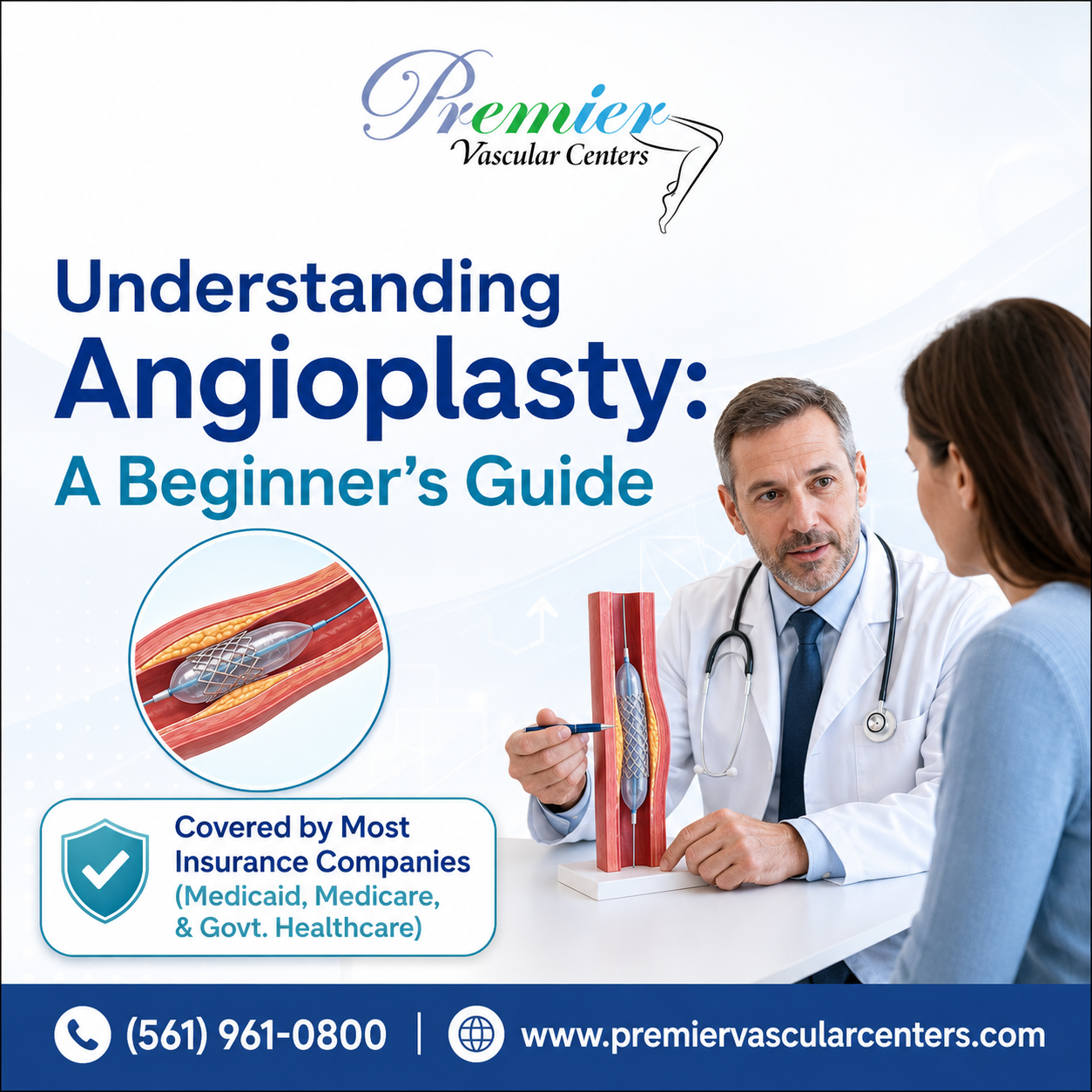
Let’s start with the word itself, because it sounds a lot scarier than it is. An angioplasty is a minimally invasive, non-surgical procedure that widens a narrowed or blocked blood vessel. That’s it. That’s the whole idea.
Think of it like your home’s plumbing. Ever noticed how old pipes build up mineral scale over time, until water barely trickles through? Your blood vessels can do the same thing, just with plaque instead of mineral deposits. Angioplasty is how a professional vascular team clears that buildup and gets things flowing again.
So What Actually Happens in an Angioplasty?
- A doctor threads a microscopic catheter — a thin, flexible tube — into the vessel through a tiny access point, usually in your wrist or groin.
- A small balloon at the tip inflates right at the blockage, pressing the plaque flat against the vessel wall and reopening the pathway.
- If needed, a stent, i.e. a small mesh tube, goes in to hold everything open for good. It is kind of like a support sleeve inside a pipe.
The best part is that it is done under local anesthesia through a tiny nick in the skin. It doesn’t involve any big incision or a week in the hospital. Most people are back to their routine within days.
Discover if you are a suitable candidate for endovascular treatments.
The Connection: How Does Angioplasty Benefit Total Vascular Health?
One common question people ask is that if angioplasty widens arteries, does it only matter for arteries? Not exactly. Angioplasty is most often used to treat Peripheral Arterial Disease (PAD), where plaque narrows the arteries feeding your legs. But it’s a genuine cornerstone of complete vascular health treatment as well.
Our circulatory system is not two separate networks. It’s one closed loop. Block the arterial “highways,” and downstream tissue starts starving for oxygen. The pressure across your entire system shifts. This imbalance rarely stays put in one spot.
The same logic holds for veins. Sometimes, the deep veins in your pelvis or legs may run into a structural bottleneck caused by a venous compression. In such times, a venous angioplasty restores that unobstructed flow back to your heart. It clears the blockage, restores steady circulation, lets the rest of the system breathe.
What does that actually mean for you?
- Blood stops pooling in your lower legs and feet
- Chronic swelling eases up
- That heavy, waterlogged feeling by dinnertime starts to fade
- Pressure that worsens varicose and spider veins gets relieved
Treating the pipes carrying blood in protects the pipes carrying blood out. They’re not separate problems, but the same problem seen from two sides. This is why a real evaluation at a dedicated center for vascular care looks at the whole picture, not just one symptom.
Signs You Might Need a Vascular Evaluation
Your legs talk to you long before something becomes serious. Are you noticing any of these?
- Cramping pain in your calf, thigh, or hip when you walk or climb stairs, that only eases once you stop and rest
- Slow-healing sores, ulcers, or discoloration on your lower legs, feet, or toes
- A heavy, tired ache in your legs that builds as the day goes on
- Unexplained coldness or numbness in one leg that just doesn’t match the other
One of these on its own? Worth a mention at your next checkup. A few together? That’s your body waving a flag. It’s tempting to chalk it up to “just getting older,” but these symptoms are usually treatable, especially when caught early.
A quick, painless ultrasound can often pinpoint exactly where the bottleneck is well before it turns into something harder to fix, like a wound that won’t heal.
Explore how vascular experts in Boca raton prefer endovascular treatments over surgery.
Protect Your Mobility With Premier Vascular Centers
At the end of the day, protecting your mobility isn’t about chasing down isolated symptoms one by one. It’s about seeing your vascular system as what it actually is: one connected whole.
Angioplasty happens to be one of the safest, most effective tools we have for restoring healthy flow, and most patients are shocked by how little downtime it actually takes.
So here’s the real question. Why keep planning your golf outings and morning walks around leg pain? If any of this sounds familiar, it might be time to talk to the trusted vascular experts in Boca Raton at Premier Vascular Centers.
Schedule a personalized consultation today, and get your mornings and your mobility back where they belong.